





Have you ever noticed the same emotional pattern returning in different forms?
Perhaps you keep choosing relationships where you feel unseen. Maybe anxiety shows up whenever you are asked to take a risk. You might overwork to prove your worth, avoid speaking up, or find yourself apologizing for having needs. Even when you are self-aware and committed to growth, certain patterns can feel remarkably persistent.
Traditional psychotherapy offers powerful tools for understanding thoughts, emotions, relationships, trauma, and behavior. But some people also long for a spiritual framework that helps them make meaning of their experiences. This is where Psychoastrology® can offer another lens.
Developed by Lisa Tahir, LCSW, Psychoastrology® brings psychology and natal astrology into conversation. It does not use astrology to predict your future or define your identity. Instead, your birth chart can serve as a symbolic map for exploring emotional themes, unconscious patterns, vulnerabilities, and potential sources of wisdom.
When your chart meets your therapy, the goal is not to blame the stars for your struggles. The goal is to understand yourself with greater compassion: and to recognize where you have the power to choose differently.
What Is Psychoastrology®?
Psychoastrology® is an integrative approach that sits at the intersection of mental health and astrology. It combines psychological insight with the symbolic language of the natal chart to help illuminate patterns that may be difficult to name through conversation alone.
Psychology can help us explore:
- How early experiences shaped our beliefs
- Why certain situations trigger strong emotional responses
- How attachment patterns influence relationships
- Which behaviors protect us but may no longer serve us
- How thoughts, emotions, and habits can be changed
Astrology, in this model, can offer a reflective framework for asking meaningful questions:
- Where do I feel most vulnerable?
- What part of myself do I struggle to accept?
- Where do I seek approval or control?
- What lessons seem to repeat in my life?
- How might my pain also point toward my strengths?
The chart is not a diagnosis, and it does not replace clinical assessment or evidence-based care. Rather, it can provide language and imagery for the inner work already happening in therapy.
At Nolatherapy, this kind of holistic therapy online may include traditional psychotherapy alongside meditation, mindset work, spirituality, energy principles, and intuitive techniques: always tailored to the individual.

The Chiron Effect: Understanding Core Wounds
A central part of Psychoastrology® is Chiron, often called the “wounded healer.” In astrology, Chiron can symbolize an area of life where we carry a deep sensitivity or recurring wound.
This wound may involve feeling rejected, unheard, unsafe, inadequate, disconnected, or unworthy. It can influence how we protect ourselves and how we interpret the world around us.
For example, someone may notice:
- A fear of taking up space or asserting themselves
- Anxiety about financial or emotional security
- A belief that they must be perfect to be loved
- A tendency to overgive while neglecting their own needs
- Difficulty trusting others with their authentic feelings
- A recurring sense of being different or misunderstood
These patterns are not proof that something is wrong with you. Often, they began as understandable adaptations to experiences that felt overwhelming, confusing, or painful.
A child who learned that their needs were inconvenient may become an adult who rarely asks for help. A person who was criticized for expressing emotion may become highly self-controlled. Someone who experienced inconsistency may attempt to manage every possible outcome.
The Chiron Effect, as described by Lisa Tahir, refers to the “orbit” we can develop around our wounding. We may unconsciously repeat familiar emotional patterns because they feel known: even when they are painful.
The healing process begins when we can observe that orbit without judging ourselves for being in it.
Lisa’s book, The Chiron Effect: Healing Our Core Wounds through Astrology, Empathy, and Self-Forgiveness, explores twelve areas of core wounding connected with Chiron’s sign and house placement. The book offers reflections, affirmations, and practical steps intended to support deeper self-understanding and healing.
How Psychoastrology Supports Personal Transformation Therapy
Personal transformation therapy is not about becoming an entirely different person. It is about becoming more conscious of who you are, what shaped you, and what you want to carry forward.
Psychoastrology® can support that process in several ways.
1. It gives you language for recurring patterns
Sometimes a person knows what they are doing but cannot explain why they keep doing it. They may understand that they are people-pleasing, overworking, withdrawing, or self-sabotaging, yet still feel unable to stop.
A chart-based conversation can offer a symbolic starting point. When a pattern has language, it becomes easier to observe. When it becomes observable, it becomes more changeable.
This does not mean the chart causes the pattern. It gives you a way to reflect on the pattern and connect it with your personal history, beliefs, and choices.
2. It can reduce shame
Shame says, “This is who I am. I am the problem.”
Compassion says, “Something happened, I developed a way to cope, and I can learn a new way to respond.”
A spiritual perspective may help you see your wounds as part of your human experience rather than evidence of personal failure. Therapy then helps you process the emotions, challenge limiting beliefs, build skills, and create healthier behaviors.
This combination can be especially meaningful for people exploring anxiety and spirituality. Anxiety may still require clinical support, regulation skills, medication, or specialized treatment. But spiritual reflection can also help someone ask, “What is this anxiety trying to protect?” or “What belief about safety, belonging, or control needs my attention?”
3. It connects insight to responsibility
Your chart may describe tendencies, but it does not determine your destiny.
This distinction is essential. Psychoastrology® is not about fatalism. It is not “I cannot change because this is in my chart.” Instead, it invites personal responsibility:
- I may have a tendency to overfunction, but I can practice receiving support.
- I may fear rejection, but I can communicate instead of disappearing.
- I may feel unworthy, but I can take one action that honors my value.
- I may have learned to avoid conflict, but I can develop respectful boundary-setting skills.
Awareness opens the door. Choice creates transformation.
A Simple Psychoastrology-Inspired Reflection Practice
You do not need to know every detail of your birth chart to begin reflecting on your emotional patterns. Try this brief practice in a journal.
Step 1: Name the repeating theme
Complete this sentence:
“The situation I keep experiencing in different forms is…”
Be specific. You might write, “I keep feeling responsible for everyone’s emotions,” or “I keep shrinking when I am invited to lead.”
Step 2: Identify the protective behavior
Ask:
“What do I do when I feel this wound being activated?”
Do you withdraw, explain, fix, criticize yourself, become controlling, overwork, or seek reassurance?
Remember that protective behaviors often developed for a reason. Meet them with curiosity rather than contempt.
Step 3: Listen for the underlying belief
Complete this sentence:
“If I do not protect myself this way, I am afraid that…”
This may reveal a belief such as:
- I will be abandoned.
- I will be exposed as inadequate.
- I will lose control.
- I will disappoint someone.
- I will not belong.
Step 4: Practice empathy and self-forgiveness
Place a hand over your heart and say:
“I understand why I learned to protect myself this way. I am allowed to learn something new.”
Self-forgiveness does not mean avoiding accountability. It means releasing the belief that punishment is required for growth. You can take responsibility for your actions while also understanding the pain beneath them.
Step 5: Choose one grounded action
Transformation becomes real through behavior. Choose one small action that supports your healing:
- Say no without offering a lengthy explanation.
- Take a real lunch break.
- Ask for clarification instead of assuming rejection.
- Share an honest feeling with a trusted person.
- Spend ten minutes resting without earning it first.
- Replace one self-critical thought with a compassionate truth.

Supporting Work/Life Balance Through a Spiritual Lens
Work/life balance is often discussed as a scheduling problem, but it can also be an identity issue.
If your sense of worth is tied to productivity, no calendar system will fully resolve the exhaustion. You may continue adding tasks because achievement temporarily quiets the fear that you are not enough.
A Psychoastrology®-informed therapy process might explore where this belief began, how it affects your body and relationships, and what it would mean to develop an identity beyond performance. You can also read more about the connection between stress and the body in this Nolatherapy resource.
Try asking yourself:
- Who am I when I am not producing?
- What would rest make possible in my life?
- Which responsibilities are truly mine?
- What am I afraid might happen if I slow down?
- Can I allow my life to have seasons of effort and seasons of restoration?
Spirituality can remind us that we are human beings, not human accomplishments. Therapy can help us turn that reminder into sustainable daily choices.
A Compassionate Invitation to Begin
You do not have to choose between psychology and spirituality. You are allowed to seek an approach that honors your emotional health, your lived experiences, your identity, your intuition, and your desire for meaning.
Psychoastrology® is one pathway for exploring that integration. Your chart may help you notice a theme, but your healing unfolds through empathy, self-forgiveness, honest reflection, supportive relationships, and intentional action.
If you are curious about your Chiron placement and the core wounds you may be ready to explore, begin with Lisa Tahir’s book:
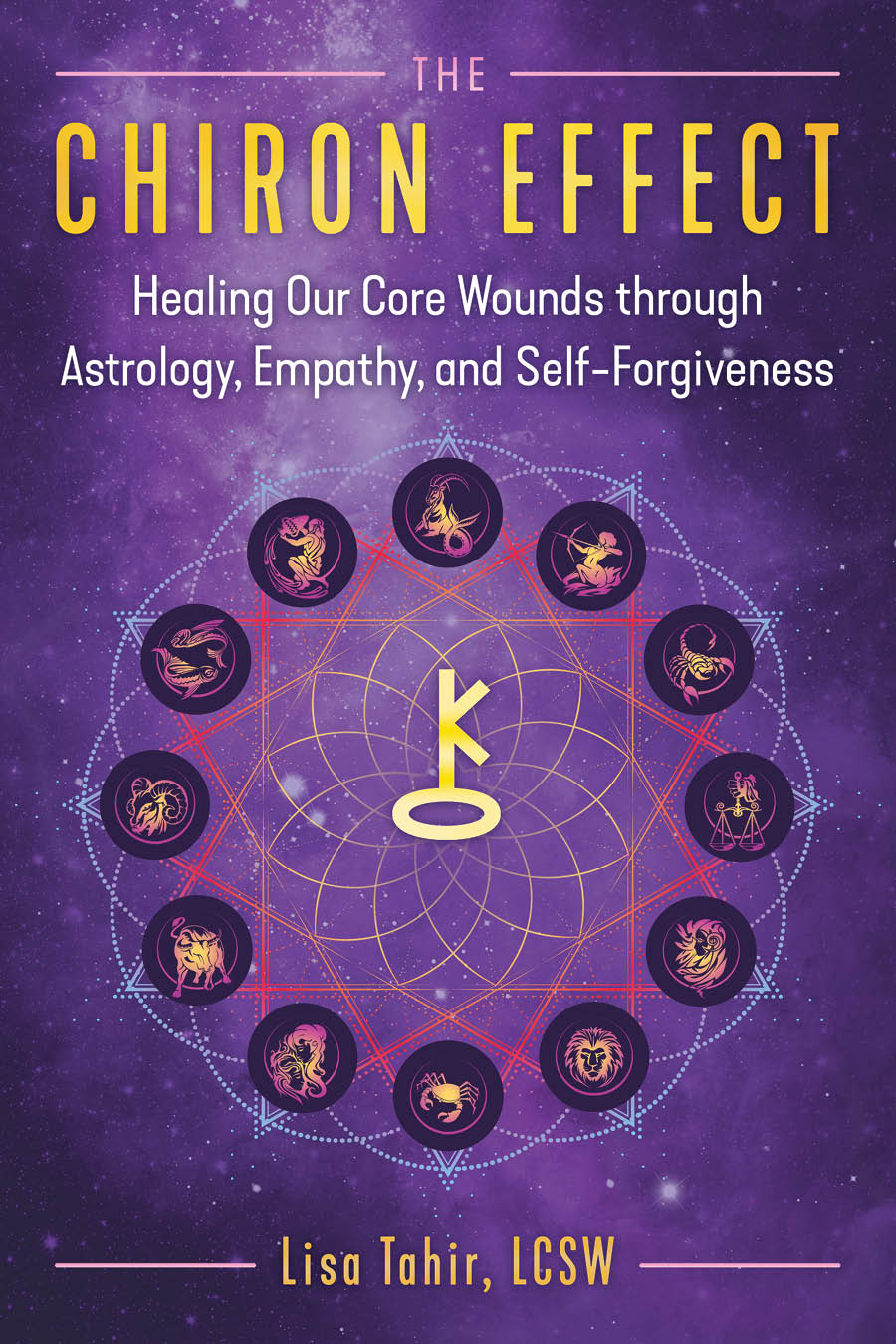
Explore The Chiron Effect by Lisa Tahir
The book is designed to help you identify recurring patterns and consider how compassion and responsibility can shift your relationship with them. It can be a meaningful companion for personal reflection or a starting point for deeper therapeutic work.
If you would like individualized support, schedule a session with Lisa to explore your goals through an integrative therapy process. Sessions are available by phone, FaceTime, or Zoom, making support more accessible wherever you are.
Your chart may be a map. Your history may explain the terrain. But you are still the one learning how to walk toward a more authentic, peaceful, and empowered life.